
AI Content Policies in 2026: Google, YouTube, and LinkedIn Rules
A deep look at the AI content policies for 2026. We cover Google's AI guidelines, YouTube's disclosure rules, and whether platforms actually penalize AI content.
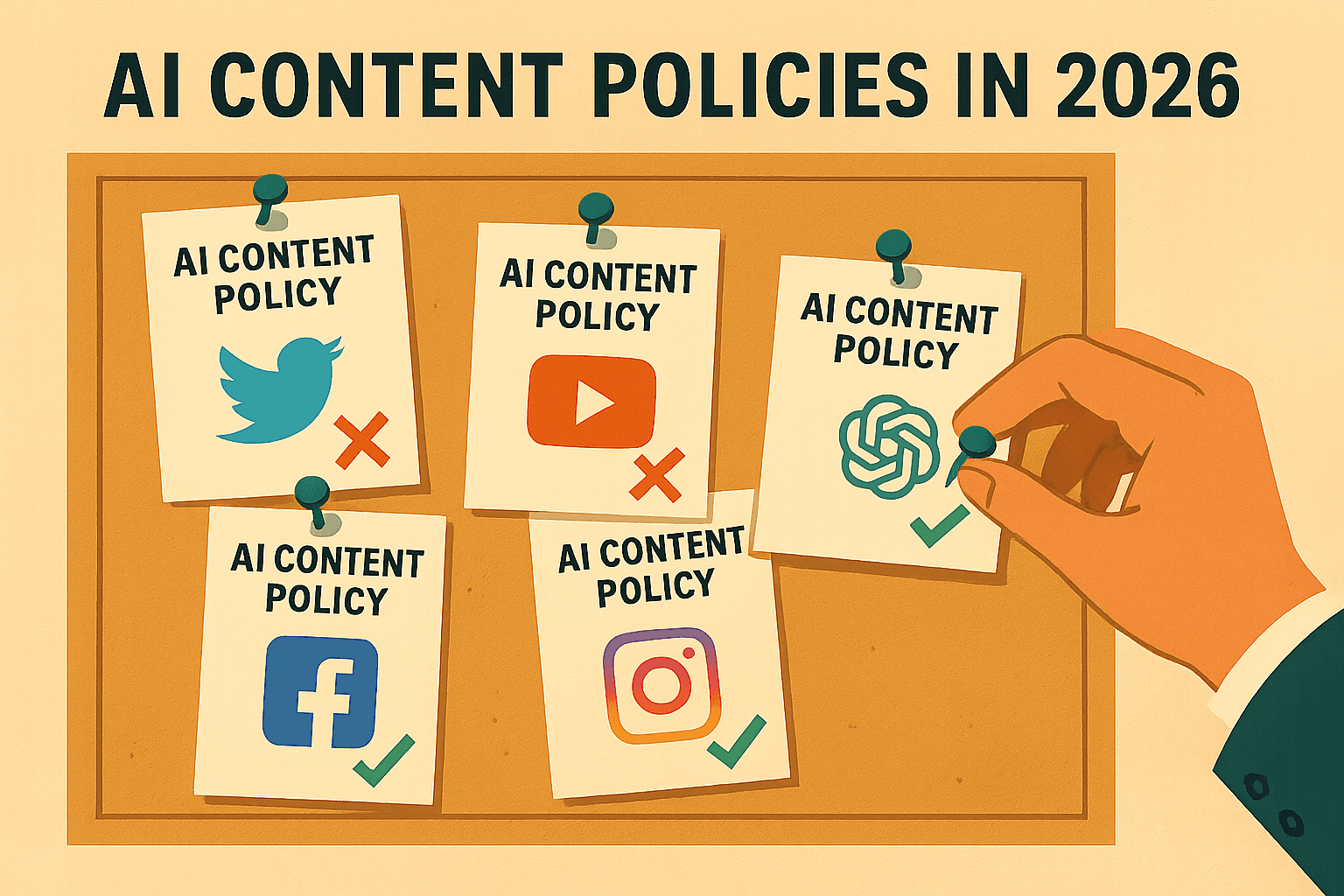
Everyone is using AI to write. Your competitor. Your boss. The intern who just produced a shockingly good report in thirty minutes. Probably your grandma. But nobody really talks about the rules. It feels like we're all driving without a license, hoping we don't get pulled over. We hit 'generate' in ChatGPT, paste it into WordPress, and hold our breath, wondering if this is the post that gets our site nuked by Google. What are the actual AI content policies in 2026? Is this all okay? Or are we building our digital empires on a foundation of algorithmic quicksand? Let's figure it out.
Does Google Actually Penalize AI Content?
Look, let's get this out of the way first. The big question. The one that keeps marketers up at night. Does Google penalize AI content? The short answer is no. The longer, more useful answer is: Google penalizes bad content, and a lot of AI content happens to be very, very bad.This isn't just my opinion. It's the entire thrust of their recent updates. Remember the chaos of the Google March 2024 core update? It wasn't an 'AI content update'. It was a 'Helpful Content' update that just so happened to wipe out a ton of sites that were using AI to produce unhelpful content at a massive scale. Google’s systems were updated to better identify content that was created for search engines instead of for people. And honestly, AI is exceptionally good at creating content that looks like it's for search engines.Think about it. What did the penalized sites have in common? They were often churning out hundreds of articles a day. The content was generic, rephrasing what was already on page one. It lacked any real experience or unique perspective. It was the digital equivalent of flavorless tofu. It filled a space but offered no real substance. The AI wasn't the problem. The strategy of using AI to create spam was the problem.On the other hand, plenty of sites use AI and rank beautifully. Ahrefs, a major SEO tool company, openly discusses using AI to assist in their content creation. Many top marketing blogs use AI for drafts, outlines, and research. The difference? A human is always in the loop. A human with actual experience is adding stories, data, and a unique point of view. They are ensuring the content meets the high standards of E-E-A-T: Experience, Expertise, Authoritativeness, and Trustworthiness.So, if your AI-assisted article about 'the best hiking boots for beginners' includes your personal story of getting blisters in Yellowstone from a bad pair, photos you actually took, and details you could only know from experience, Google will probably love it. If your article is just a sanitized list of affiliate links scraped from other blogs and rewritten by a bot, you’re playing with fire. The future of AI content policies in 2026 is less about the 'how' and all about the 'what'. What value are you providing to a real human being?
Google's Actual Policy (What They've Said on Record)
You don't have to guess what Google thinks. They've been pretty clear about it, even if the message gets lost in a sea of panicked blog posts. For years, Google’s stance has been consistent, just worded slightly differently over time.Google Search Liaison, the official voice for this sort of thing, has stated it plainly. Here’s the money quote from their own documentation on creating helpful content: “Our focus is on the quality of the content, rather than how the content is produced.”They literally do not care if you wrote it with a quill pen by candlelight, dictated it to an assistant, or used an advanced AI model. They care if the final product is good. They go on to say that using AI isn't against their guidelines. However, using it “primarily to manipulate search rankings” is very much against their guidelines. That’s the nuance everyone misses. They aren't banning the tool; they are banning the spammy application of the tool.Think of AI like a kitchen knife. You can use it to expertly prepare a wonderful meal. Or you can use it to, well, do things that will get you in trouble. Nobody blames the knife manufacturer when someone does something bad. Google is taking the same approach. They know AI can be used to scale up the creation of original, helpful, interesting content. It can also be used to generate thousands of pages of garbage designed to capture a few clicks before the user bounces.So, when you're planning your content strategy, the question isn't 'Is it okay to use AI?'. The right question is 'Is this content helpful, reliable, and people-first?'. If you use AI to achieve that, you are perfectly aligned with Google's AI content guidelines. If you use AI as a shortcut to avoid doing the hard work of creating something valuable, you are in direct opposition to their guidelines. It's that simple. And that complicated.
YouTube's AI Disclosure Requirements
Okay, moving from text to video. YouTube is a different beast, and its AI rules are much more explicit. This makes sense. AI-generated video and audio can be much more deceptive than text. So, YouTube rolled out a clear AI disclosure policy.In your YouTube Studio dashboard, when you upload a video, there's now a section that asks you to declare if your content contains “altered or synthetic media.” You’re presented with a couple of checkboxes. You MUST disclose AI use in a few specific scenarios:Using the likeness of a real person: Did you use AI to make it look like a real individual said or did something they didn’t? You have to disclose it. This is the anti-deepfake rule.Altering footage of real events or places: Did you add a CGI monster to a real video of New York City? Or make it look like a real building caught fire when it didn't? Disclose it.Generating a realistic-looking scene that didn't happen: If you create a completely synthetic but photorealistic scene, like a fake car crash or a political event, you need to let viewers know.When you check that box, YouTube might add a label to your video's description, like “Contains synthetic content.” For particularly sensitive topics (like health, news, or elections), they might show a more prominent label on the video player itself.So what don't you have to disclose? YouTube says you don't need to check the box for things like AI-generated scripts, content ideas, or captions. You also don't need to disclose things that are clearly unrealistic, like an animated cartoon set on Mars or using AI filters to give yourself purple hair. They are concerned with deception, not creativity.The penalties for not disclosing are real. If you fail to label your content correctly, YouTube could remove it. They might also suspend you from the YouTube Partner Program, which means no more ad revenue. For creators, the YouTube AI disclosure rules are not something to ignore. It’s better to be transparent. Your audience will probably think it’s cool anyway.
LinkedIn's Stance on AI-Written Content
LinkedIn is fascinating because its AI policy is less about official rules and more about social physics. The platform doesn't have a checkbox that says 'This post was written by a bot'. But it has something far more powerful: the collective judgment of its users.LinkedIn's official Professional Community Policies forbid 'misinformation' and 'inauthentic behavior', which could theoretically apply to a bot pretending to be a human thought leader. But in practice, the penalty isn't a ban; it's being ignored. LinkedIn's algorithm is designed to promote engaging content. And purely AI-generated content is almost always the opposite of engaging.You've seen these posts. They start with a generic, over-enthusiastic hook. They use a lot of business jargon. They have a weirdly symmetrical structure with bullet points that all sound the same. They lack personal anecdotes, genuine emotion, and any semblance of a unique voice. They are perfectly polished and utterly forgettable.So, does LinkedIn detect AI posts? Not in a technical, 'this text scores 98% robotic' kind of way. The algorithm 'detects' it because humans detect it. When a user scrolls past a post because it feels soulless, that's a negative signal. No likes. No comments. No shares. The algorithm learns from this and buries the post. The penalty for bad AI content on LinkedIn isn't from the platform; it's from the audience.Smart creators on LinkedIn use AI the same way smart bloggers do: as an assistant. They might ask an AI, 'Give me five ideas for a post about team management.' Then they'll pick one and write it themselves, adding a story about a time their own team struggled and what they learned. They might use AI to check grammar or rephrase a clunky sentence. The LinkedIn AI writing policy is an unwritten one, enforced by the users themselves: be human, be interesting, or be invisible.
Platform-by-Platform Policy Comparison for 2026
Keeping track of the AI content policies for 2026 across every platform is a headache. So, I put together a big comparison table. This is the lay of the land right now. Of course, these things change, but the general direction is toward transparency and quality.A quick note on 'Detection Method': Most platforms don't use a simple 'AI detector' tool because they are notoriously unreliable. Instead, they rely on a mix of signals. These include the scale of content production (is one account posting 500 articles a day?), user reports, and algorithmic analysis of content quality and engagement. It's more sophisticated than just scanning for robotic text.table{width:100%;border-collapse:collapse;margin:20px 0;}th,td{border:1px solid #ddd;padding:12px;text-align:left;}th{background-color:#f2f2f2;font-weight:bold;}tr:nth-child(even){background-color:#f9f9f9;}PlatformAllows AI Content?Requires Disclosure?Penalizes Detected AI?Detection Method UsedGoogle SearchYes, if it's high-quality and helpful.No, but recommends author transparency.Only if it's low-quality spam created at scale.Algorithmic (Helpful Content system, spam signals, scale analysis).YouTubeYes.Yes, for realistic altered or synthetic media that could mislead viewers.Yes, for non-disclosure. Penalties include content removal or channel suspension.User reporting and internal review. Relies on creator honesty.LinkedInYes, unofficially.No formal requirement.No, but the algorithm penalizes low-engagement (robotic) content by reducing its reach.Algorithmic (based on user engagement signals like likes, comments, dwell time).MediumYes.Yes, requires clear labeling of AI-generated stories (for stories largely written by AI).Yes, can affect distribution and curation if not properly disclosed.Internal review and user reporting.Twitter / XYes.No formal requirement for text, but has policies against deceptive synthetic media.Yes, for content that violates its synthetic and manipulated media policy (e.g., political deepfakes).User reporting and algorithmic flagging.Amazon KDPYes.Yes, authors must inform Amazon if content is AI-generated (distinction between AI-assisted and AI-generated).Potentially, if it leads to a poor customer experience or violates other content guidelines.Author disclosure during the publishing process.Instagram / FacebookYes.Yes, 'Made with AI' labels are being rolled out for photorealistic video and images.Yes, for non-disclosure or content that violates community standards.Algorithmic detection of AI markers and user reporting.TikTokYes.Yes, creators must use the 'AI-generated' label for realistic-looking content made with AI.Yes, for non-disclosure. Content may be removed.In-app tools and user reporting.
The Difference Between AI-Assisted and AI-Generated
This distinction is becoming incredibly important. It's the difference between getting a helpful suggestion and getting your content flagged. Understanding it is key to navigating AI content policies in 2026.AI-Assisted is when a human is the primary creator, using AI as a tool to enhance their work. Think of it like a very advanced assistant. This includes:Using AI to brainstorm topics or create an outline.Asking AI to summarize long research papers.Using AI to rephrase a sentence to make it clearer or more concise.Generating a list of potential titles for your blog post.Using AI-powered tools like Grammarly for spelling and grammar checks.In this scenario, the core ideas, the voice, the perspective, and the final judgment all come from you. The AI is a co-pilot, not the pilot. Most platforms have zero issues with this. It's just an evolution of the creative process.AI-Generated is when the AI is the primary creator. The human's role is more of an editor or prompter. This includes:Giving a prompt like 'write a 1000 word blog post about digital marketing' and publishing the output with minimal changes.Creating an entire video script or book chapter using AI.Automating the creation of hundreds of product descriptions without human review.This is where platforms start to get nervous. It's where you see rules about disclosure (like on YouTube and Amazon KDP) and where Google's spam policies might kick in if the content is low-quality and produced at scale. The creative spark is outsourced.So where do AI humanizers fit in? I think they occupy a space in between, leaning heavily towards the 'assisted' side. A humanizer isn't creating new ideas. It's taking existing text (whether written by a human or an AI) and refining its style, structure, and word choice to improve its readability for a human audience. It's an advanced editing tool. You're still responsible for the facts and the core message. It's polishing, not creating from scratch.
What Actually Gets Your Content Penalized
Let's be brutally specific. It's not the presence of AI that gets you in trouble. It’s the bad habits that AI makes easy. If you're seeing your rankings drop or your engagement plummet after using AI, it's almost certainly due to one of these factors, not because a magic AI detector scanned your site.Thin Content Produced at Scale. This is Google's public enemy number one. Using AI to create 500 flimsy, 300-word blog posts that barely scratch the surface of a topic is a huge red flag. It screams 'I'm trying to game the system'. Quality over quantity has never been more important.Lack of Original Value. If your article is just a mashup of information already available in the top five search results, it has no reason to exist. Google calls this 'unhelpful' content. AI is great at summarizing, but it struggles to add unique insights, personal experiences, or new data. That's your job. If you don't add value, you're just noise.Factually Incorrect Information. AI models are notorious for 'hallucinating' or just making things up with complete confidence. Publishing AI content without meticulous fact-checking is a recipe for disaster. It destroys user trust and is a massive negative quality signal.Missing E-E-A-T Signals. Where is the author bio? Is the author a real person with demonstrable experience in the topic? Is the website trustworthy? Does the content cite its sources? AI-generated content often exists in a vacuum, lacking these critical human-centric trust signals. You need to build them around the content.Poor User Experience. This is a big one. Content that is hard to read gets penalized by users leaving your site. This can be caused by predictable, robotic sentence structures, a lack of formatting (like headings and bullet points), or a generally boring and monotonous tone. If a user clicks, gets confused or bored, and leaves, that's a signal to Google that your page isn't helpful.Deception and Non-Disclosure. On platforms like YouTube and TikTok, this is an explicit policy violation. Trying to pass off a synthetic video of a person as real without telling your audience is a fast track to getting your content removed. Transparency is your best defense.Notice that 'written by AI' isn't on the list. That's because it's a method, not a quality. The list above is all about quality and intent. Fix these issues, and the origin of the text becomes irrelevant.
How Content Creators Are Using AI Without Getting Flagged
So, how are the pros doing it? The successful bloggers, marketers, and creators aren't just copy-pasting from ChatGPT. They've developed sophisticated hybrid workflows that blend AI efficiency with human creativity. It’s a partnership, not a replacement.A typical professional workflow might look something like this:1. Ideation and Research (The AI's Job): It starts with a conversation with an AI like Claude 3 or Perplexity AI. The creator will feed it a broad topic and ask for keyword clusters, common questions people ask (for a FAQ section), and potential angles for an article. They might ask it to summarize a few dense research reports to get the key data points quickly. The AI does the heavy lifting of gathering and structuring raw information.2. Outlining and Structuring (A Collaboration): The creator takes the AI's raw output and shapes it into a compelling narrative. They create the H2s and H3s, decide the flow of the article, and identify where personal stories or unique data will be inserted. The structure is human-led, informed by AI-powered research.3. First Draft (The Human's Job): This is the most important step. The creator writes the first draft. They inject their unique voice, their opinions, their humor, and their experiences. They tell the stories that only they can tell. They write the introduction that hooks the reader and the conclusion that provides a clear takeaway. The core of the article is human.4. Refinement and Polish (The AI's Job, with Supervision): Once the human draft is done, AI comes back in. The creator might paste a paragraph into an AI and ask, 'Can you make this sound more punchy?' or 'Check this for clarity'. This is where tools like AI humanizers also come into play, helping to smooth out awkward phrasing and ensure a natural reading experience. It’s an editing pass, not a writing pass.This hybrid approach is the secret. It uses AI for what it's good at (speed, data processing) and humans for what they are good at (creativity, experience, emotional connection). The final product is high-quality, valuable, and uniquely human, even though AI was involved every step of the way.
Where AI Humanizers Fit in Platform Compliance
There's a lot of chatter about AI humanizers. Are they for 'cheating' AI detectors? Honestly, that's the wrong way to look at them. Focusing on detector scores is a losing game because the detectors aren't very reliable, and it's not what platforms like Google are actually looking for.A better way to think about humanizers is as advanced editing tools. They sit alongside established software like Grammarly and the Hemingway Editor. Grammarly fixes your grammar. Hemingway makes your sentences clearer and more direct. A humanizer improves the rhythm, flow, and naturalness of your text.AI models, even the best ones, tend to fall into predictable patterns. They often use the same sentence structures, overuse certain transition words, and maintain a very even, formal tone. A humanizer is designed to break these patterns. It might rephrase a passive sentence into an active one, combine two short sentences into a more complex one, or swap out a common word for a more interesting synonym. The goal isn't to change the meaning or the facts; it's to improve the reader's experience.In the context of platform compliance, this is a huge benefit. Remember, a major reason content gets penalized is poor user experience. If your text is robotic and hard to read, people leave. A humanizer helps solve that problem. It makes the text more engaging and easier to digest. So, it's not about fooling a machine. It's about better serving a human. And that is perfectly in line with the AI content policies of every major platform.
Bottom Line
So, what's the final word on AI content policies in 2026? It's this: stop worrying about the tool and start obsessing over the quality. The rules are all converging on a single, timeless principle. Create things for humans. Be helpful. Be interesting. Be trustworthy. Whether you use a team of writers, a solo genius in a coffee shop, or a sophisticated AI model to get there is becoming less and less relevant. The platforms are getting better at sorting the valuable from the valueless. Your job is to make sure you're on the right side of that line. Use AI to augment your humanity, not replace it. If you do that, you'll be just fine.
Frequently asked questions
01Will Google de-index my entire site if I use AI content?
It's extremely unlikely. Google penalizes pages or sections of a site for low-quality, unhelpful content. De-indexing an entire site is reserved for massive, systematic policy violations, like large-scale spam generation. Using AI to assist in writing helpful articles will not get your site de-indexed.
02Do I need to put a disclosure on my blog posts saying I used AI?
Currently, there is no requirement from Google to do so. However, transparency can build trust with your audience. Some publications add a small note explaining their editorial process and how they use AI as a tool. It's a good practice, but not a technical requirement for ranking.
03Are AI content detectors reliable?
Honestly, not really. Studies have shown that AI detectors have a high rate of false positives (flagging human text as AI) and can be easily bypassed. Even OpenAI discontinued its own detector due to low accuracy. This is why platforms focus on quality signals rather than relying on these tools.
04Can I use AI to rewrite or 'spin' other people's articles?
This is a bad idea. While technically different from plagiarism, it's exactly the kind of low-value, unoriginal content that Google's Helpful Content system is designed to penalize. You are adding no new value, simply rephrasing what already exists. Focus on creating something original.
05What is the main difference between YouTube's and Google's AI policies?
The main difference is the requirement for disclosure. Because video and audio can be used for more realistic deception (e.g., deepfakes), YouTube has a strict policy requiring you to label realistic AI-altered content. Google Search has no such requirement for text-based articles.
06Does using an AI humanizer violate Google's policies?
No. Using a tool to improve the readability and flow of your text is considered part of the editing process. It's no different from using Grammarly or the Hemingway App. As long as you are responsible for the factual accuracy and originality of the core ideas, using a humanizer to refine the final text is perfectly acceptable.
07What's the best way to use AI on LinkedIn?
Use it for brainstorming, not for writing the final post. Ask it for data points, interesting questions, or different angles on a topic. Then, write the post yourself using your own voice and a personal story. The LinkedIn algorithm rewards authenticity, which is something AI cannot fake.
08Will AI content policies become stricter by 2026?
They will likely become more nuanced and specific, especially around disclosure for visual media. However, the core principle will probably remain the same: platforms will reward high-quality, human-centric content and penalize low-quality, manipulative content, regardless of how it was made.
09Can I get in legal trouble for using AI content?
It depends. If you use AI to generate defamatory content, copyrighted material (like images of characters or song lyrics), or deepfakes of individuals without consent, you could face legal issues. You are always responsible for the content you publish, regardless of its origin.